
Financing Journey Improvements
How we redesigned a solar financing experience to reduce onboarding friction, improve operational efficiency, and unlock revenue growth.

Business Context
The Solar Credit product, launched in 2022, experienced significant operational bottlenecks as proposal volume increased without corresponding improvements to the platform.
My role
As the Product Designer, I was responsible for:
Diagnosing journey and conversion bottlenecks
Planning and facilitating discovery activities
Conducting stakeholder workshops and co-creation sessions
Defining information architecture and interaction flows
Designing end-to-end improvements across the onboarding and financing journey
Collaborating closely with Product, Business, and Engineering teams
Context
Lack of transparency throughout the financing journey generated a high volume of support requests, increasing operational costs and negatively impacting conversion.
Out of 20,850 submitted proposals, 81.8% were rejected at the beginning of the funnel, primarily due to documentation errors, unclear requirements, and process complexity.
Research phase
Due to timeline constraints, we adopted a lean discovery approach by leveraging existing meetings with customers and commercial partners.These conversations provided valuable insight into real-world workflows, operational challenges, and customer behavior throughout the financing process.We also analyzed competitor solutions to understand which experience patterns reduced friction and improved financing conversion.
Key Insights
Users had low digital maturity
Most borrowers were senior customers with limited familiarity with digital products and little to no prior experience applying for financing.
Long response times reduced conversion
The lengthy analysis process created uncertainty and caused users to abandon applications before completion.
Communication was difficult to understand
he commercial proposal relied on highly formal language and complex tabular layouts, reducing readability and creating confusion for the target audience.
Critical actions lacked clarity
System statuses and required user actions shared the same visual hierarchy, making it difficult for users to understand what needed attention and causing avoidable errors throughout the journey.
Hypotheses
Hypothesis 1
If we simplify the language and structure of the commercial proposal, making it more accessible to first-time borrowers, users will better understand the financing offer and be less likely to abandon the process.
Hypothesis 2
If we establish a clear distinction between required actions and system feedback, users will make fewer mistakes during onboarding, reducing rejection rates at the top of the funnel.
Soluções: Atuação em pontos de fricção no fluxo
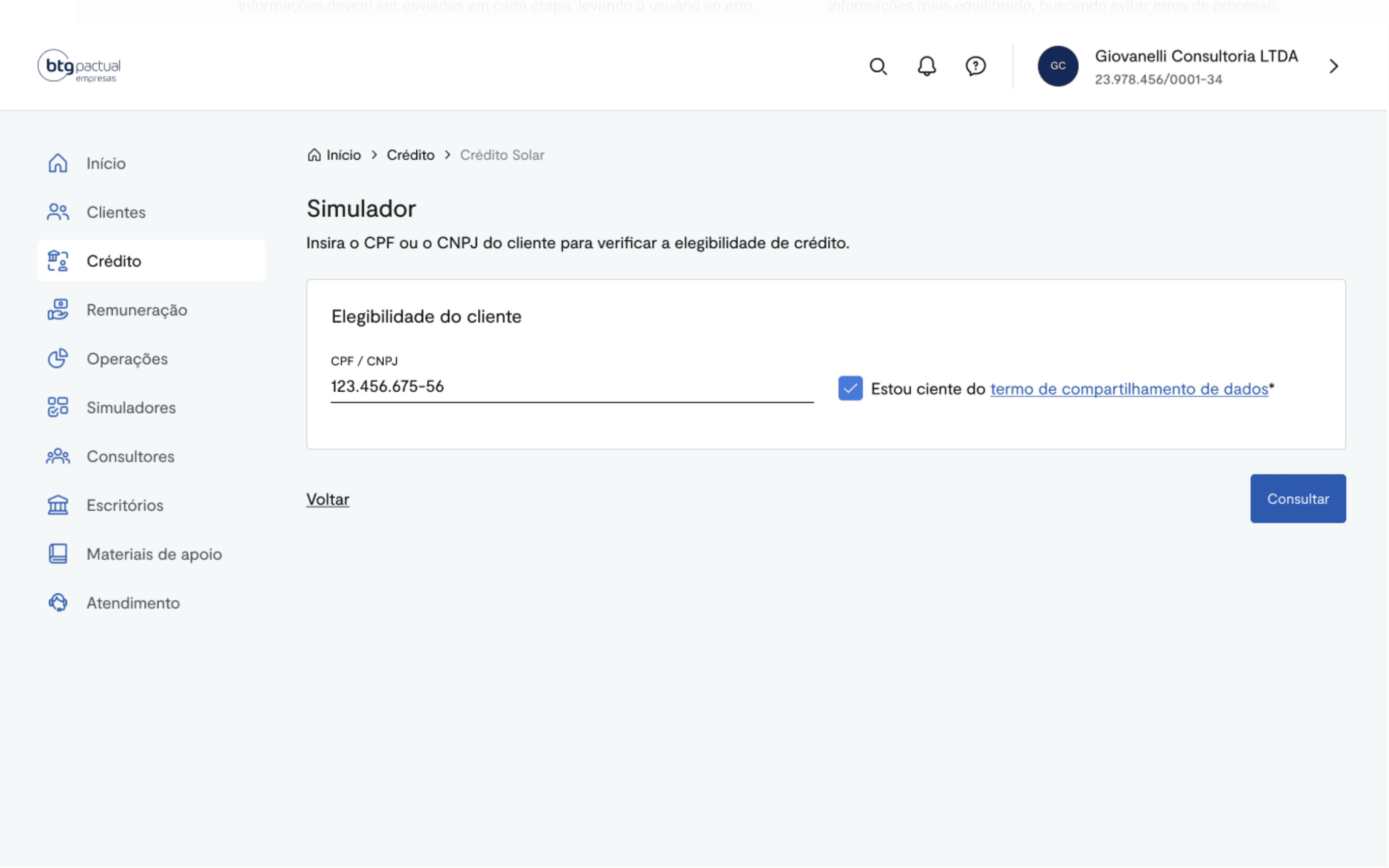


Instant financing simulation
We introduced an integrated financing simulator that generated a commercial proposal with minimal user input.
This allowed customers to quickly understand financing conditions before committing to the full application process.
Simplified commercial proposal
We redesigned the proposal experience using clearer language, improved content hierarchy, and a more readable visual structure while maintaining legal compliance requirements.
Additionally, proposals became instantly available via email and printable immediately after generation.


Antes


Depois


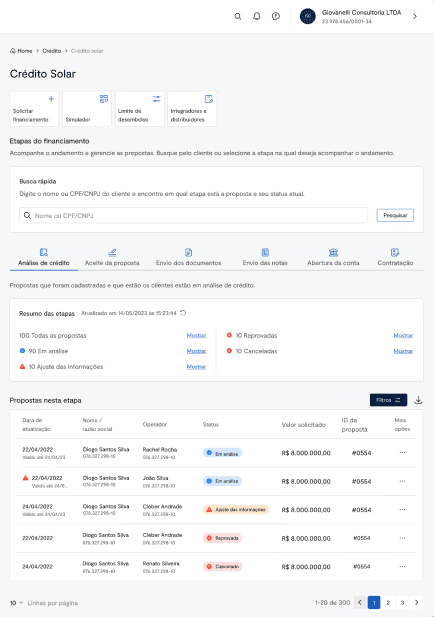
Redesigned onboarding journey
We restructured the experience by clearly separating:
Required user actions
Process statuses
System notifications
This reduced ambiguity, improved scanability, and created a more intuitive onboarding experience.
Impact
17,6%
reduction in rejection rates during onboarding and document submission
3x faster
analysis, approval, and digital contract signing process
+8,7%
increase in signed contracts and completed financing proposals
By simplifying the experience for a low digital-maturity audience and clarifying the distinction between actions and status updates, we significantly reduced onboarding errors that historically blocked users at the top of the funnel.
With more accurate submissions from the start, the financing operation became more efficient, reducing processing time and enabling partners to convert more proposals into signed contracts.
The result was a simpler customer experience, lower operational costs, and measurable business growth.

